Other Names (How it Got Its Names)
Common names: Tarapoto Imitator Dart Frog, Tarapoto Morph.
Ranitomeya = “tree frog,” imitator = “imitator,” due to the species’ mimicry of other dart frogs in the wild.
“Tarapoto” refers to the locality in Peru where this morph originates.
Characteristics
Small, colorful dart frog known for its strong parental care.
One of the only dart frogs known to form monogamous pairs in the wild.
Hardy for a Ranitomeya, making it popular in the hobby.
Recommended Vivarium Size
Minimum: 18” x 18” x 18” for a pair or trio.
Vertical enclosures (24” tall or more) are ideal.
Provide bromeliads, cork tubes, leaf litter, and dense live plants.
Temperature
Daytime: 72–78°F (22–25°C).
Nighttime: 68–72°F (20–22°C).
Avoid temps above 80°F.
Humidity
80–100%, maintained with misting and live planting.
Bromeliads or water-holding plants are essential for tadpole rearing.
Size of Frog
Adults: ~0.75–1 inch (2–2.5 cm).
Life Span
8–12 years in captivity with proper care.
Feeding
Small prey: Drosophila melanogaster and D. hydei fruit flies, springtails, isopods.
Feed daily; dust feeders with calcium and multivitamins 2–3 times weekly.
Color/Pattern
The Tarapoto morph typically has a bright orange to red head and dorsum with black banding or blotches.
Limbs are usually blue to turquoise with black reticulations.
Bold, high-contrast coloration similar to R. fantastica, but smaller and with different parental behaviors.
Social Behavior
Best housed in pairs or trios.
Known for pair-bonding and cooperative parental care.
Less aggressive than larger Dendrobates, but visual barriers help reduce stress.
How to Determine Sex
Males: smaller, slimmer, produce soft buzzing calls.
Females: larger, fuller-bodied, especially when gravid.
Juveniles are difficult to sex until maturity.
How to Breed
Provide film canisters, petri dishes, or bromeliads for egg deposition.
Males call to attract females; eggs are laid on smooth, moist surfaces.
Both parents transport tadpoles to bromeliads or small pools of water.
Tadpoles are fed unfertilized eggs by the female until metamorphosis.
✨ Ranitomeya imitator “Tarapoto” is admired for its brilliant orange-and-blue contrast and dedicated parental care, making it both stunning and fascinating to keep.
Other Names (How it Got Its Names)
Common names: Yumbatos Imitator Dart Frog, Yumbatos Morph.
Imitator = “imitator,” named for the species’ ability to mimic the appearance of other dart frogs.
“Yumbatos” is the locality in Peru where this morph originates.
Characteristics
Small, active, arboreal frog.
Known for strong parental care — one of the few dart frog species to exhibit monogamy.
The Yumbatos morph is bold and colorful, making it a standout in the imitator group.
Recommended Vivarium Size
Minimum: 18” x 18” x 18” for a pair or trio.
Vertical setups (24” tall or more) are ideal with bromeliads, cork, and climbing structures.
Provide dense planting for cover and egg deposition sites.
Temperature
Daytime: 72–78°F (22–25°C).
Nighttime: 68–72°F (20–22°C).
Avoid temps above 80°F.
Humidity
80–100%, maintained with misting and live plants.
Bromeliads or similar water-holding plants are essential for tadpole transport.
Size of Frog
Adults: ~0.75–1 inch (2–2.5 cm).
Life Span
8–12 years in captivity with proper care.
Feeding
Small prey: Drosophila melanogaster and D. hydei fruit flies, springtails, and isopods.
Feed daily; dust prey with calcium and vitamins several times weekly.
Color/Pattern
Yumbatos morph typically shows bright orange to red head and dorsum, with black banding or blotches.
Limbs often show blue or turquoise reticulated patterning.
The vivid orange/blue contrast makes this morph especially attractive.
Social Behavior
Best housed in pairs or small groups (1 male with 1–2 females).
Known for pair-bonding and cooperative parental care.
Less aggressive than larger Dendrobates species, but space and visual barriers reduce stress.
How to Determine Sex
Males: smaller, slimmer, with soft buzzing calls.
Females: larger, fuller-bodied, especially when gravid.
Juveniles are difficult to sex until adulthood.
How to Breed
Provide film canisters, petri dishes, or bromeliads for egg-laying sites.
Males call to attract females; eggs are laid on moist surfaces.
Both parents participate in transporting tadpoles to bromeliads or small water bodies.
Tadpoles are often fed unfertilized eggs by the female until metamorphosis.
✨ The Ranitomeya imitator “Yumbatos” is prized for its striking orange-and-blue coloration and strong parental care behaviors, making it a favorite among dart frog keepers.
Other Names (How it Got Its Names)
Common names: Southern Variabilis Poison Dart Frog, Southern Variable Dart Frog.
Variabilis = “variable,” named for the species’ wide range of color and pattern morphs.
The “Southern” morph refers to populations from southern Peru, which show distinctive coloration compared to northern/local morphs.
Characteristics
Small arboreal dart frog with bold coloration.
Active and visual, often perching on leaves and mid-level plants.
Known for being one of the more adaptable Ranitomeya species in captivity.
Recommended Vivarium Size
Minimum: 18” x 18” x 18” for a pair or trio.
Taller enclosures (24” high or more) preferred, with bromeliads and vertical climbing options.
Provide live plants, leaf litter, cork, and multiple hiding areas.
Temperature
Daytime: 72–78°F (22–25°C).
Nighttime: 68–72°F (20–22°C).
Avoid temps above 80°F.
Humidity
80–100%, with daily misting.
Requires bromeliads or water-holding plants for tadpole transport.
Size of Frog
Adults: 0.75–1.1 inches (2–2.8 cm).
Life Span
8–12 years in captivity with proper care.
Feeding
Diet: small insects — Drosophila melanogaster and D. hydei fruit flies, springtails, isopods.
Feed daily; dust prey with calcium and vitamins several times weekly.
Color/Pattern
The Southern morph typically shows a bright yellow or green body with heavy black reticulated (net-like) markings.
Limbs are usually blue or turquoise with black webbing.
Pattern is less variable than northern/local morphs, with a more consistent reticulated look.
Social Behavior
Best housed in pairs or trios; small groups possible if space is sufficient.
Males may call frequently; visual barriers reduce territorial stress.
Not as aggressive as Oophaga, but still monitor group interactions.
How to Determine Sex
Males: smaller, slimmer, with soft buzzing/trill calls.
Females: larger, rounder when gravid.
Juveniles can be difficult to sex until maturity.
How to Breed
Provide film canisters, petri dishes, or bromeliads for egg laying.
Males call to attract females; eggs are deposited on smooth, moist surfaces.
Parents transport tadpoles individually to bromeliads or small water pools.
Tadpoles feed on detritus and microfauna; some parental care may include egg feeding depending on locality.
Metamorphosis occurs in ~2–3 months.
🌿 The Southern R. variabilis is admired for its clean, reticulated pattern and vivid blue legs, making it one of the more visually striking Ranitomeya morphs.
Our Pigment Enhancement Formuls is a Carotenoid Supplement designed to enhance the diet of Reptiles, Fish, Amphibians and birds.
Not for human consumption.
Our Micro Fine Vitamin A Supplement for Reptiles and Amphibians. Contains Preformed Vitamin A as well as Natural Ingredients which provide Beta Corotene. Not for human consumption.
Species: Scindapsus pictus
Other Names:
Satin Pothos
Silver Pothos
Silver Vine
Silk Pothos
Botanical cultivars include:
Scindapsus pictus 'Argyraeus' (small silver dots)
Scindapsus pictus 'Exotica' (larger leaves and patches of silver)
Scindapsus pictus 'Silvery Ann'
Native to: Southeast Asia, including: Thailand, Malaysia, The Philippines, Bangladesh and Indonesia
Temperature preferences:
Ideal: 65–85°F (18–29°C)
Avoid temperatures below 60°F (15°C) - sensitive to cold drafts
Water preferences:
Prefers moderate watering
Let the top 2 inches of soil dry out before watering again
More drought-tolerant than many tropicals, but don’t let it dry out completely for long periods
Use well-draining soil to avoid root rot
Terrestrial or Epiphytic: Epiphytic in it's natural habitat (Grows on trees with aerial roots but can be potted terrestrially indoors)
General Information and Care:
Satin Pothos (Scindapsus pictus) is a beautiful trailing or climbing vine admired for its velvety, heart-shaped leaves with shimmery silver variegation. It's often mistaken for pothos (Epipremnum), but it has a softer texture and slower growth rate.
Light: Bright, indirect light is best. Tolerates low light, but silver variegation may fade. Avoid direct sun.
Soil: Use a well-draining potting mix (aroids mix or regular mix with perlite)
Humidity: Prefers moderate to high humidity (50%–70%) but adapts well to average household levels
Growth Habit: Trailing or climbing; great for hanging baskets or moss poles
Toxicity: Toxic to pets if ingested (contains calcium oxalates)
Highlights:
Velvety silver-patterned foliage adds elegance to indoor spaces
Low-maintenance and forgiving — great for beginners
Grows well in low to medium light, making it perfect for offices or lower-light rooms
Versatile: can be trained to climb or trail
Popular in tropical and minimalist decor aesthetics
Shipped Size: A separation with established roots.
Species: Solanum sp. 'Ecuador'
Native to: Ecuador
Temperature preferences: Warm to cool growing
Water preferences: Medium moisture
Terrestrial or Epiphytic: Epiphytic or Terrestrial
General Information and Care: Solanum sp. 'Ecuador' is a vine that is an easy to grow terrarium species. The vine adds interest to any habitat. It will climb along the ground or up towards the light. As a young plant, the leaves are small at less than an inch. Solanum sp. 'Ecuador' grows best with higher humidity. To establish a cutting, simply place on a bed of moist sphagnum and give it medium to high light and keep it humid. This species establishes easily and will grow rapidly.
Highlights:
Vine
Fast growing
Deep Green with bright green veining
Terrestrial and Air plant
Shipped Size: Tip cutting with at least 10 leaves.
Highlights:
Holds moisture
Helps maintain high humidity
Long fibers
2 oz package
Finn's Frog Farm Sphagnum Moss can help create a humidity rich environment in your bioactive habitat due to its ability to retain a large amount of water. This is a great addition to your substrate layer for many different dart and tree frog species. Sphagnum moss can also aid in growing different varieties of plants.
Highlights:
Universal food for varieties of springtails
Can use on clay, dirt, or charcoal substrates
Shaker container
4 ounces
Powder
Finn's Frog Farm springtail food is a powder and comes in a shaker container. This 4 ounce jar is packed full of nutrients that springtails will enjoy. Sprinkle a little bit of food on the springtail cultures 1-2 times per week or when no food is visible.
When caring for springtail cultures vent containers twice a week, keep moist, and feed once a week. Cultures can take up to five weeks to reproduce again.
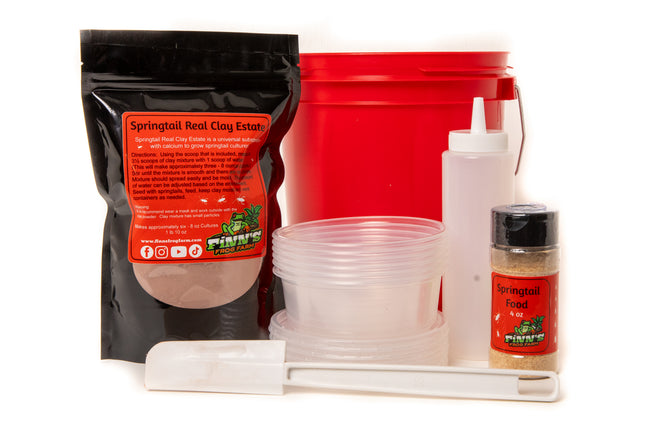
Highlights:
One gallon bucket and lid
Springtail Real Clay Estate Mixture with scoop
Springtail Food
Squeeze Bottle
Spatula
Six 8 ounce containers and lids
Finn’s Frog Farm Springtail Kit includes everything that is needed to begin culturing springtails. Clay as the substrate for springtails makes it easy to seed habitats, feed from, and continue to produce new springtails.
Use the measuring scoop included in the Real Clay Estate Mixture to mix clay and water. The kit will make six - 8 ounce cultures. Choose to make all the cultures at once or make as needed. The kit includes a spatula to spread the clay on the cups.
Feed the springtails using Finn’s Frog Farm Springtail Food, vent the lid twice a week and keep the clay moist using the water bottle that was included.